I have had students come to me after years on sleeping pills. Students who had not slept through the night in a decade. Mothers up at 3am every morning, mind racing, body exhausted. Executives who would pass out but wake feeling like they had not rested at all.
In almost every case, within 3-4 weeks of a consistent bedtime pranayama practice, something shifted. Not because pranayama is magic — because it directly addresses the actual cause of most modern sleep problems: a nervous system that cannot switch off.
🕉 The Yogic View of Sleep: Classical texts describe sleep (Nidra) as one of the five Vrittis — fluctuations of the mind. Poor sleep happens when these mental fluctuations do not settle at night. Pranayama quiets the Vrittis from the body upward — through the breath and nervous system — making it more reliable than purely mental approaches to sleep.
Why You Cannot Sleep — and What Pranayama Actually Does About It
Insomnia is almost always a nervous system problem, not a mind problem. The body is physiologically locked in sympathetic (fight-or-flight) activation when it needs to transition into parasympathetic (rest-and-digest) mode for deep sleep. The harder you try to sleep, the more you activate the sympathetic system. It is a trap.
Learn This Practice on YouTube — Free
Yogacharya has 96 free guided practice videos. Watch the technique demonstrated — then come back and read the full guide.
The breath is the only autonomic function you can voluntarily control — which makes it the fastest route to shifting that nervous system state. Extended exhalations stimulate the vagus nerve directly, triggering parasympathetic activation within minutes. This is not theory. This is basic physiology that sleep researchers now actively study.
🔬 Research: A 2019 study in the Journal of Clinical Sleep Medicine found that pranayama-based breathing practices significantly reduced insomnia severity, sleep onset latency, and nighttime waking compared to control groups. The effects were comparable to low-dose pharmacological interventions — without any side effects or dependency.
The 4 Best Pranayama Techniques for Sleep
1. 4-7-8 Breathing (Based on Classical 1:4:2 Ratio)
This is the single most effective immediate technique I have found for sleep induction — especially useful when the mind is racing and will not let go.
- Sit or lie on your back. Close your eyes.
- Exhale completely through your mouth.
- Inhale slowly through the nose for a count of 4.
- Hold the breath gently for a count of 7.
- Exhale completely through the mouth for a count of 8, with a soft sound.
- Repeat 4 full cycles. Most people are deeply relaxed or asleep before finishing.
Why it works: The extended exhale (8 counts) strongly activates the vagus nerve. The breath hold (7 counts) builds a mild CO₂ increase that acts as a natural sedative.
2. Bhramari (Humming Bee Breath) — 5 Minutes Before Bed
Bhramari is one of the most powerful practices for quieting an overactive mind. The internal vibration created by the humming sound resonates in the skull and sinuses, creating a direct calming effect on the nervous system.
- Sit comfortably. Close your ears with your thumbs and cover your eyes gently with your fingers.
- Inhale fully through the nose.
- On the exhale, make a deep, steady humming sound — like a bee. Feel the vibration in your skull.
- Inhale again. Repeat 7-10 times.
- After the last round, sit in complete silence for 2 minutes. The contrast is profound.
Why it works: The humming stimulates the vagus nerve through vibration. Studies show it also increases nitric oxide production in the sinuses — which has direct relaxing effects on the cardiovascular and nervous systems.
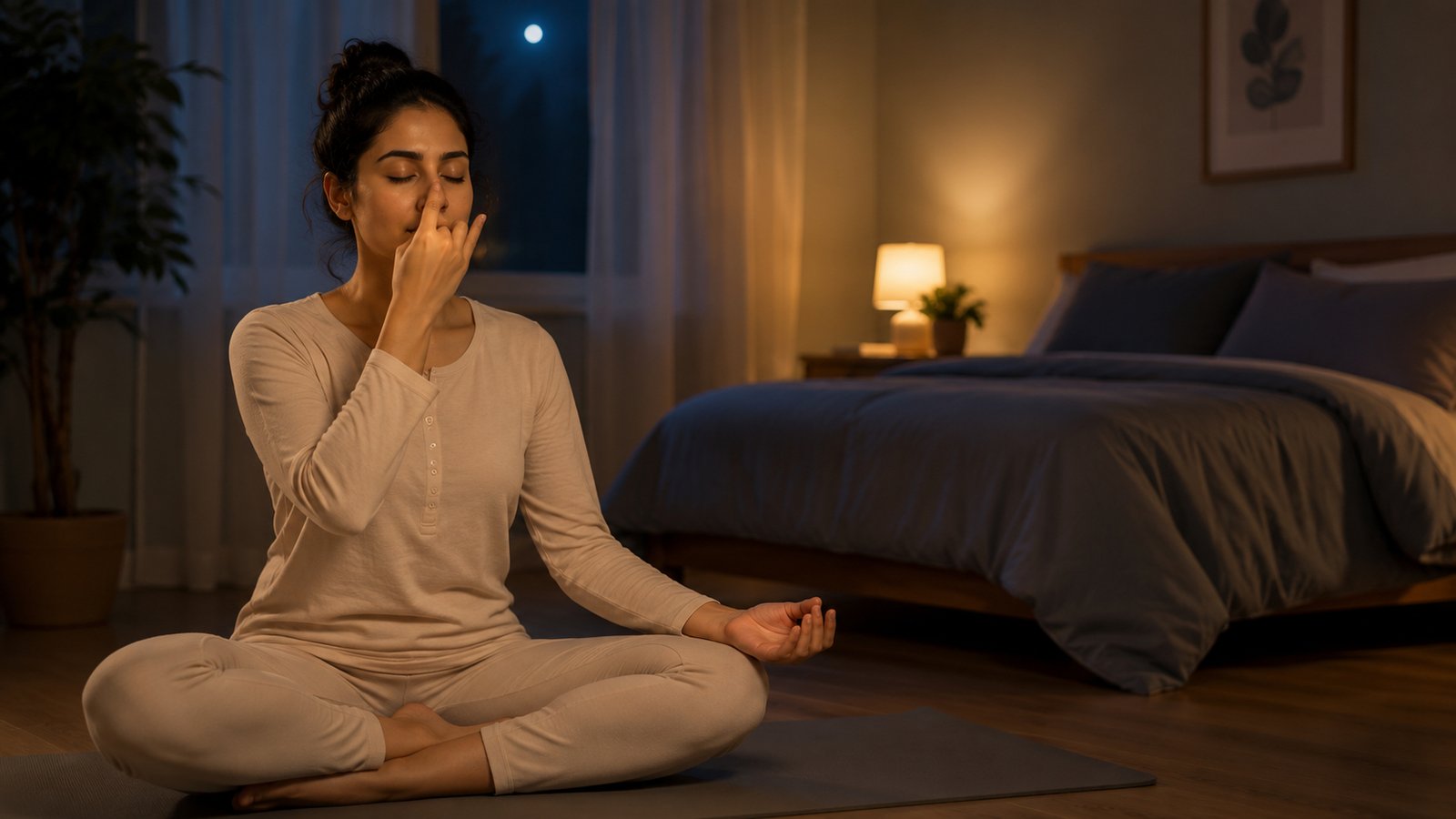
3. Anulom Vilom (Alternate Nostril Breathing) — Balanced, Not Activating
Most people know Anulom Vilom as a general pranayama. What fewer people know is that the ratio you use determines its effect. For sleep: slower is better, and the exhale should be longer than the inhale.
- Use right hand. Thumb closes right nostril, ring finger closes left.
- Inhale through LEFT nostril for 4 counts.
- Close both nostrils. Hold for 2 counts only — do not build pressure.
- Exhale through RIGHT nostril for 8 counts. Slow, controlled.
- Inhale right for 4. Hold 2. Exhale left for 8. This is one cycle.
- Do 10-12 cycles. The double-length exhale is the key.
Why it works: Left-nostril dominance activates the right hemisphere and parasympathetic nervous system. The extended exhale amplifies this effect.
4. Sheetali / Sitali (Cooling Breath) — For Overheating and Anxiety
If you tend to feel hot in bed, or if anxious heat is part of your sleep disruption, Sitali is remarkable. It physically cools the body and settles what Ayurveda calls excess Pitta — the fire element that, when imbalanced, creates irritability, racing thoughts, and difficulty sleeping.
- Roll your tongue into a tube (if you can — it is genetic). If not, part your lips and breathe through the teeth.
- Inhale slowly through the rolled tongue or teeth — feel the cool air.
- Close the mouth. Exhale slowly through the nose.
- Do 10-15 rounds, or until you feel physically cooler and calmer.
🙏 Yogacharya's note: The sequence I recommend most for sleep issues: 5 minutes of Anulom Vilom → 7 rounds of Bhramari → 4 cycles of 4-7-8. Done in bed, lights off, phone away. In my experience teaching this to hundreds of students, the ones who do this consistently for 21 days without skipping rarely report ongoing sleep problems. The rare exceptions almost always have an underlying medical issue worth investigating separately.
How to Build Your Bedtime Pranayama Routine
- Time: 15-20 minutes before you want to be asleep — not lying in bed already frustrated that you cannot sleep.
- Environment: Dim the lights 30 minutes before. Screens off. The body's melatonin production is triggered by darkness, and pranayama amplifies this natural process.
- Position: Sitting upright for the first two techniques (Bhramari, Anulom Vilom), then lying in Shavasana for the 4-7-8 technique as you transition into sleep.
- Consistency: The first week may produce modest results. By week 3, the body starts anticipating sleep when you begin the sequence — it becomes a conditioned relaxation trigger.
What to Avoid Before Sleep
- Kapalbhati at night — it is energising, stimulating, and will keep you awake. Morning practice only.
- Bhastrika at night — same reason. This is a morning activation practice.
- Any practice with long breath retention (Kumbhaka) — retention increases energy and alertness. Not what you want at 10pm.
Frequently Asked Questions
How quickly will I see results?
Most people notice something in the first 3-5 sessions — a greater ease of falling asleep, or waking feeling slightly more rested. Meaningful, consistent results typically take 2-3 weeks of daily practice. The body needs time to recalibrate its nervous system baseline.
Can I do this if I have sleep apnoea?
Certain pranayama practices are very helpful for mild-to-moderate sleep apnoea (particularly the ones that strengthen respiratory muscles). However, consult your doctor first if you have a diagnosed condition. Do not stop any prescribed treatment without medical guidance.
Is it safe to do pranayama lying down?
For sleep-specific practices — yes, with one exception: avoid lying down for Bhramari, as the ear pressure can be uncomfortable in that position. For Anulom Vilom and 4-7-8, lying on your back works perfectly.
Related: Bhramari Pranayama — Full Guide → | Pranayama for Anxiety →
Start Your 7-Day Pranayama Journey — Free
Ancient Vedic techniques for anxiety, sleep & calm. Delivered to your inbox one day at a time. No experience needed.