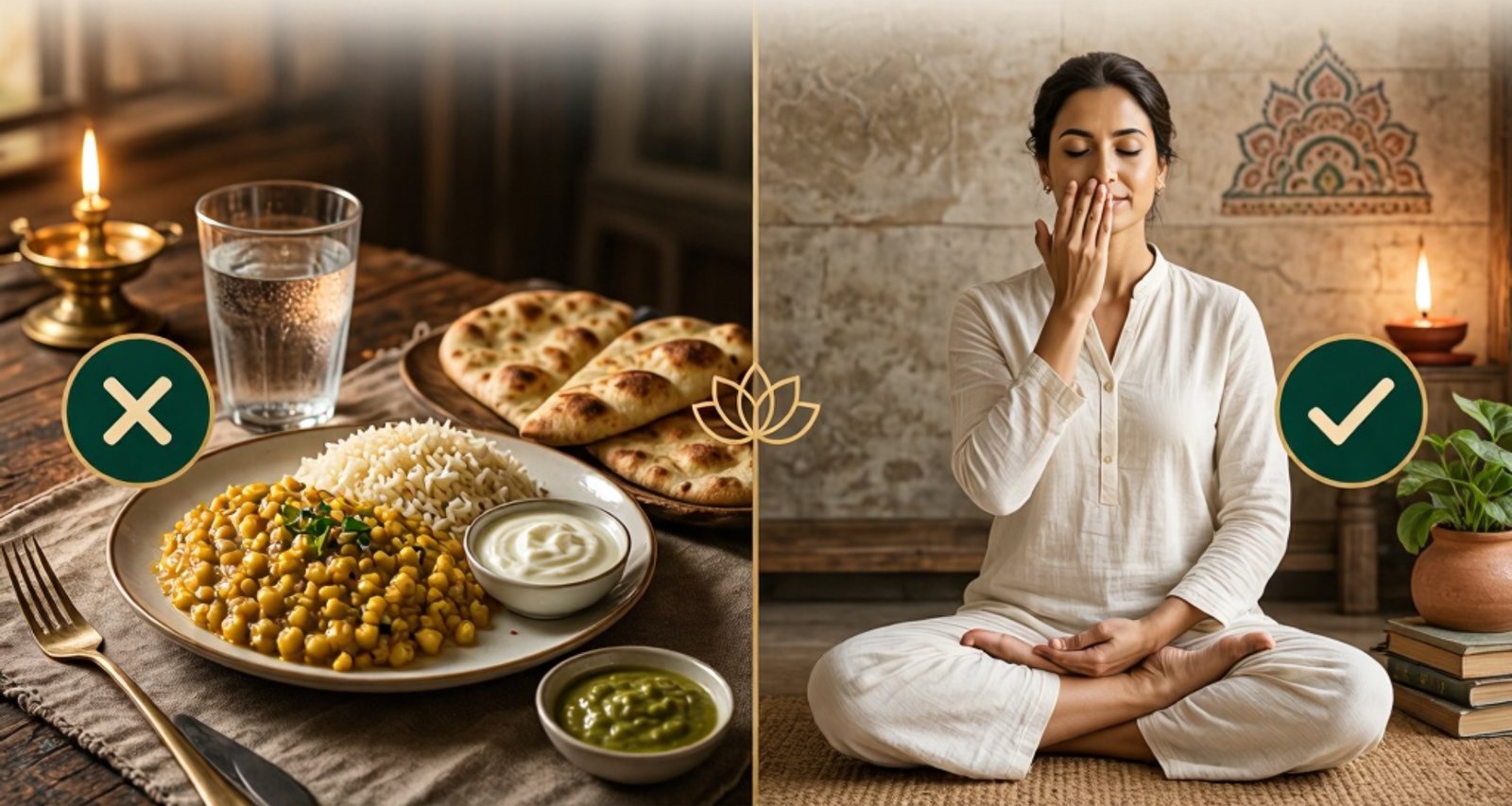
You should not practice pranayama immediately after eating. Wait at least 3–4 hours after a full meal, or 1–2 hours after a light snack. Kapalbhati and Bhastrika require the longest gap. Gentle Nadi Shodhana without retention and Bhramari are the most forgiving, but an empty stomach is always best.
Why Food and Pranayama Do Not Mix
Pranayama — especially Kapalbhati and Bhastrika — requires active abdominal movement. A full stomach physically restricts the diaphragm and abdominal cavity, preventing the full movement that makes these techniques effective. Practicing with a full stomach causes nausea, discomfort, and significantly reduced effectiveness.
Additionally, digestion requires significant blood flow and nervous system resources. Pranayama redirects these resources toward a different process — one that requires the body to be in a baseline, undivided state.
| Technique | Wait After Full Meal | Wait After Light Snack | Notes |
|---|---|---|---|
| Kapalbhati | 4 hours minimum | 2 hours minimum | Abdominal movement — most sensitive to food |
| Bhastrika | 4 hours minimum | 2 hours minimum | Same reason — full abdominal movement required |
| Nadi Shodhana (with retention) | 3 hours | 1–2 hours | Retention adds pressure — wait longer |
| Nadi Shodhana (no retention) | 2 hours | 1 hour | Most forgiving of the main techniques |
| Bhramari | 2 hours | 1 hour | Less abdominal involvement |
| Ujjayi | 2–3 hours | 1 hour | Moderate abdominal involvement |
| Sitali / Sitkari | 2 hours | 1 hour | Light technique — relatively forgiving |
The Best Time to Practice
First thing in the morning before any food or drink is the ideal time for pranayama for two reasons: the stomach is completely empty, and the mind is freshest before the day begins. Even a glass of water is fine; a full meal is not.
If morning is not possible, evening practice — 3–4 hours after the last meal and before dinner — is the next best option.
Student question: A student once asked me: "I wake up at 6am, eat breakfast at 7am, and want to practice at 8am. What do I do?" The answer is simple: practice before breakfast. Swap the order. The body functions better with pranayama before food anyway — you will likely be less hungry, and the food will be better digested.
What Happens If You Practice Too Soon After Eating
- Nausea — especially with Kapalbhati and Bhastrika
- Discomfort from restricted diaphragm movement
- Reduced effectiveness — the technique cannot be executed fully
- Acid reflux in some practitioners
- General heaviness and fatigue rather than the intended energy
Start Your Free 7-Day Breathwork Challenge
Ancient pranayama techniques. Step-by-step daily practice. Transform your nervous system in one week.